Imagine
What futures are possible, and how do we design for them?
Envision alternative futures and prototype ethical, explainable systems, exploring multiple plausible futures rather than predicting one.

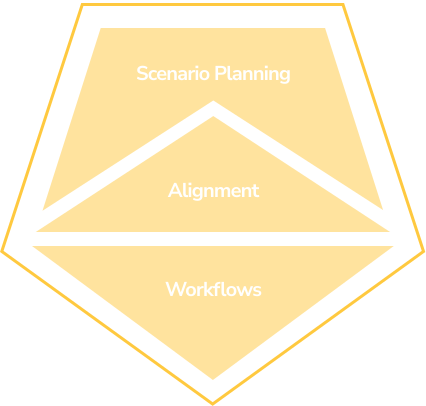
Scenario Planning
What could go wrong in each world?
Build four futures from your tensions and pressure-test the design against each.
A 2×2 matrix built from two critical uncertainties, generating four named, vivid, contestable worlds your product must hold up in.
Read the guide →
A communication pattern that separates user errors (“try this instead”) from system failures (“we made a mistake”), each with its own recovery path.
Read the guide →

Alignment
What path connects the future to today?
Trace how the desired future reaches back into present interactions.
A visioning and backcasting exercise: describe the user's day-in-the-life at future horizons, then reverse-engineer the journey back to a concrete first action.
Read the guide →

Workflows
How does the system learn, decide, and explain?
Architect feedback loops, autonomy, rewards, and explainability.
A dual-signal design pattern (explicit ratings plus implicit behavioural cues) specifying how the AI learns and when that learning changes behaviour.
Read the guide →
A contextual policy built on the 10-level autonomy scale (Sheridan & Verplank): a default level plus escalation and de-escalation rules.
Read the guide →
A pre-launch audit that writes the AI's reward function in plain English and maps its proxies to real user outcomes, paired with a transparent explanation of each automated decision.
Read the guide →